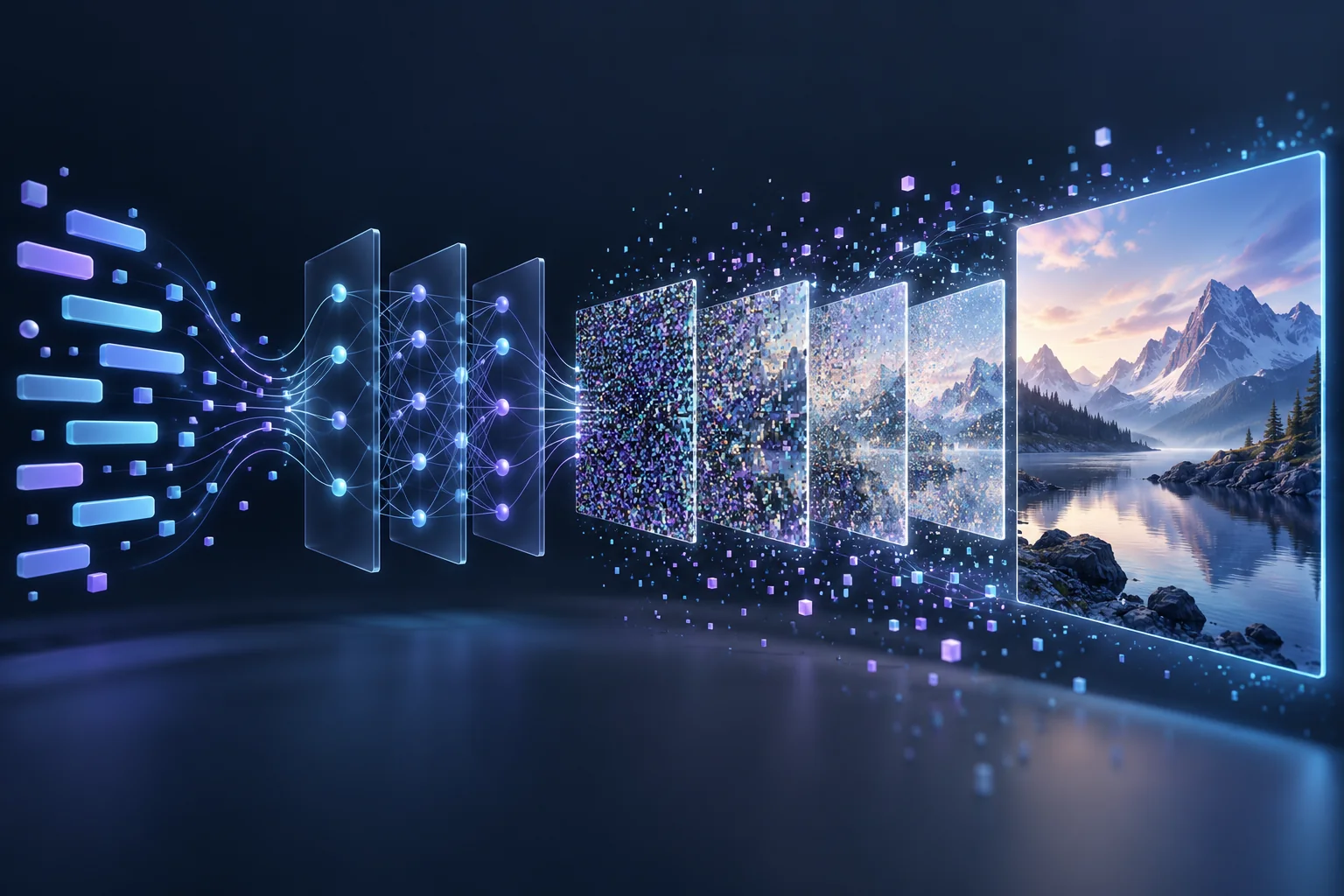
AI image generation uses a trained model to construct an image from inputs such as a written description or an existing picture. The output is synthetic: its appearance is not proof that the depicted place, object or event existed in front of a camera.
Understanding that basic distinction is more useful than memorising product names. It explains both the creative possibilities and the need to evaluate generated images carefully.
Training and generation are different stages
During training, a model's parameters are adjusted using examples and an objective. During generation, the trained model uses its parameters and the supplied inputs to produce an output. These stages should not be confused with a simple search engine retrieving a photograph that exactly matches a description.
That explanation is not a promise that models can never reproduce or closely resemble training material. Questions about memorisation and data rights need their own evidence. It simply describes why generation cannot be understood as looking up a guaranteed factual image of the requested scene.
One common approach is diffusion
In a simplified account of diffusion, training teaches a model to work with noisy image representations, and generation uses a learned process to progressively form an image from noise. Google Research's explanation of diffusion models describes this family of methods and its use in image synthesis.
Not every image model uses an identical architecture. Some operate in a compressed representation rather than directly on full-resolution pixels, and a product may combine several processing stages. The description above is a conceptual introduction, not a specification for every service.
For a neutral example, imagine an instruction describing a blue ceramic cup beside a yellow book. A system must represent the objects, their colours and their relationship. Producing a plausible desk scene is easier to judge at a glance than confirming that every requested detail is correct.
Instructions guide an output but do not verify it
Text-conditioned systems use a representation of the instruction to influence generation. The original Imagen research describes a combination of text encoding and diffusion-based image synthesis. Such conditioning helps connect language to visual output, but it is not a guarantee of exact compliance.
A generated cup may be the wrong colour or appear on the wrong side of the book. Those errors help explain why image artifacts and inconsistencies require inspection even when the overall picture looks convincing.
Why repeated requests can look different
Generation can involve random starting conditions as well as the supplied instruction. Model versions and processing choices can also affect results. Two images based on similar wording may therefore differ in layout or detail.
Variation is not necessarily a fault in an artistic application. It becomes a problem when a reader mistakes an invented detail for a recovered fact. A generated reconstruction of a damaged sign, for example, may contain plausible letters without establishing what the original sign actually said.
Editing can involve generation too
An existing photograph can become part of a hybrid image if software generates a replacement region or extends its borders. The file can contain both captured and invented content. See AI-generated images versus edited photos for why a simple “real or fake” label can be insufficient.
When sharing synthetic content, describe meaningful changes clearly and preserve available provenance information. For learning or demonstrations, ordinary objects and landscapes are sufficient. A realistic image should be treated as an illustration unless there is separate evidence supporting any factual claim made about it.
Related reading
AI-Generated Images vs Edited Photos: What Is the Difference?