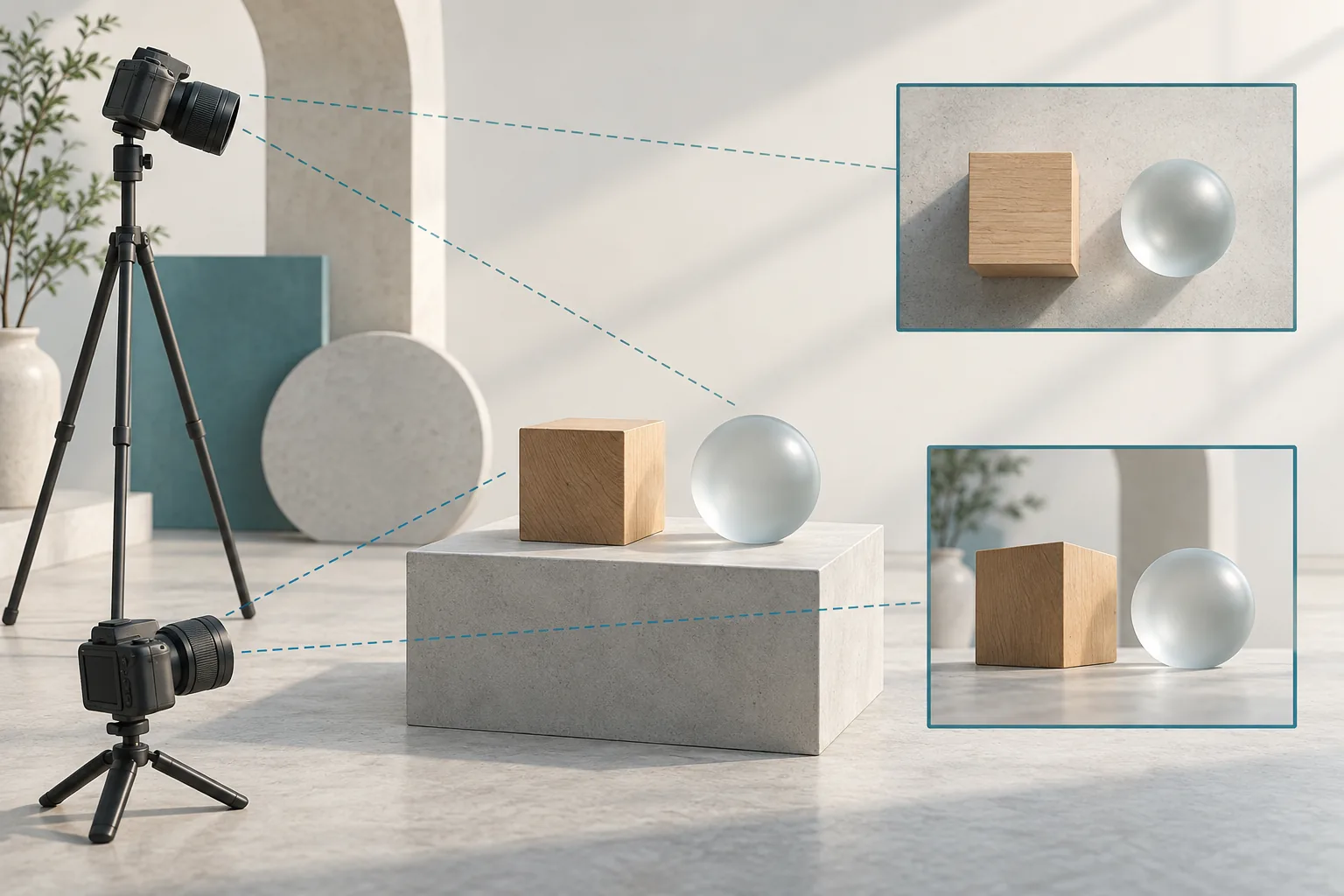
Pose and camera angle affect what a photograph shows and what remains uncertain. A two-dimensional picture captures one viewpoint, not a complete measurement of a person. When a system generates additional details, those details should not be mistaken for evidence about the real subject. This is especially important for intimate fabrications.
A photograph contains a limited viewpoint
Parts of a scene can be hidden behind objects or outside the frame. A viewer may infer what is missing from context, but an inference is not an observation. Image generation can make that inference appear complete even when no source evidence establishes the invented details.
Consider an ordinary photograph in which a hand is partly behind a chair. There can be more than one plausible position for the hidden fingers. A generated continuation chooses a possibility; it does not retrieve a definitive record of the unseen hand.
Perspective affects appearance
Objects closer to a camera can appear larger relative to more distant objects. Framing and perspective can therefore change apparent proportions without changing the person. A synthetic edit can introduce further changes, making comparisons between images especially unreliable.
This is a reason to avoid statements about someone's anatomy based on a generated picture. It is not a method for selecting photographs for intimate transformation. The responsible conclusion is that an image has evidential limits, however convincing its surface appearance may be.
Occlusion introduces uncertainty
When one part of a scene overlaps another, the image does not show all their boundaries. Generated images may represent those relationships inconsistently. Even a consistent result remains an invented representation of what the source did not establish.
For media literacy, it is useful to distinguish three things: what is visibly present in the source, what the caption claims and what a later image adds. Combining those categories can turn an illustration into an unsupported factual claim.
Do not use appearance as an age check
A person's age cannot be reliably established from their pose, clothing or apparent maturity in one image. When content involves a minor or someone whose age is uncertain, intimate transformation is not an acceptable experiment. A synthetic label does not remove that concern.
How to explain an example without exposing someone
Use a neutral object or non-sensitive diagram to explain perspective. There is no need to publish intimate before-and-after images of an identifiable adult to teach this concept. If an article discusses an existing fabrication, describe the limitation and direct affected readers to reporting help rather than displaying the image.
These limits also matter when interpreting before-and-after examples that appear to show a transformation.
Frequently asked questions
Can a generated second view establish hidden details
No. It can invent a plausible viewpoint, not verify an unseen one.
Does perspective make an image fake
No. Perspective occurs in genuine photography too.
Can a generated image prove someone's real proportions
No. It is not a reliable measurement of the depicted person.
Related guides
Why UndressHer AI Produces Image Artifacts