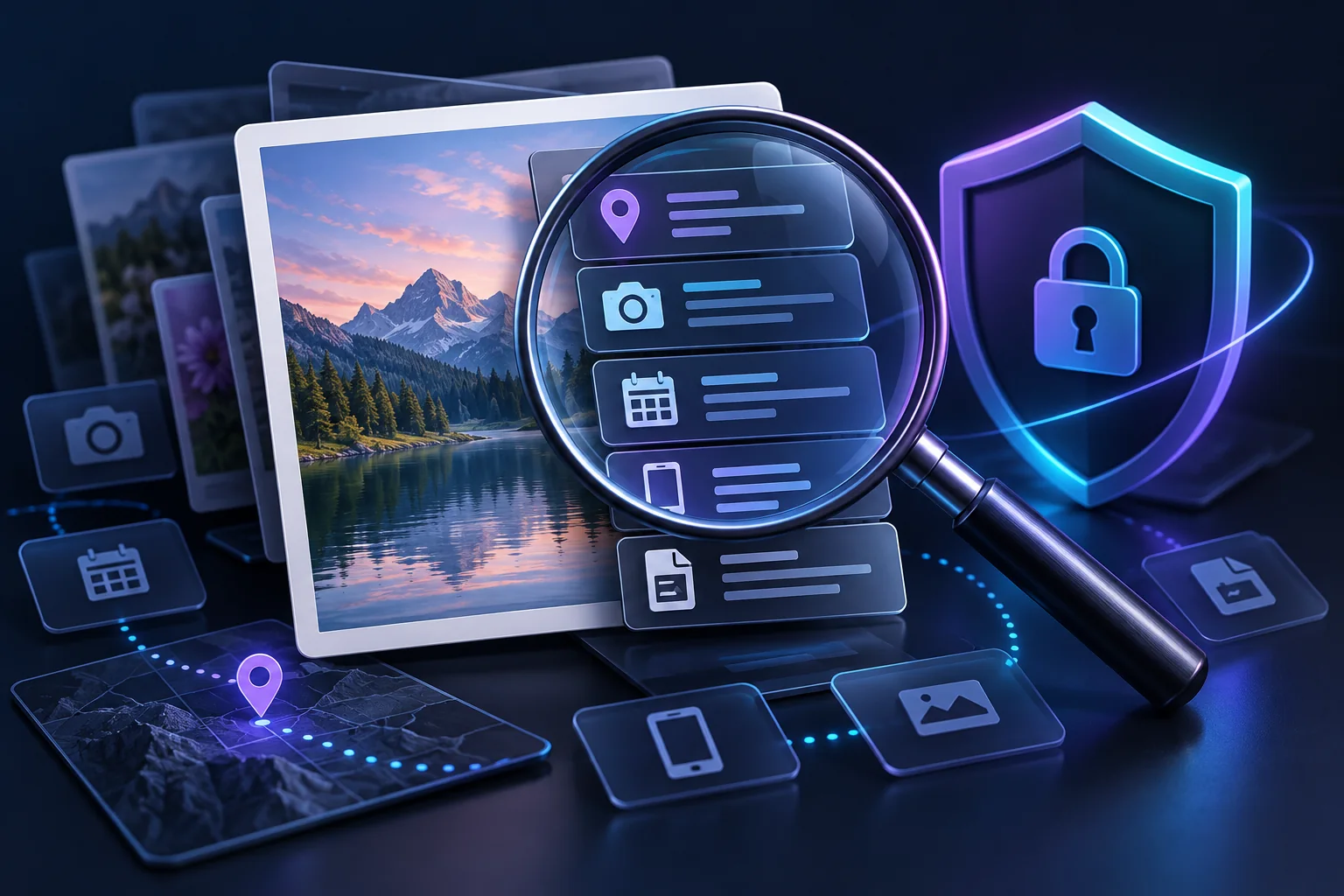
A photo file can contain information beyond the pixels you see. Depending on how it was created and exported, metadata may describe the capture time, device, location, caption or creator. Not every file contains every field, and some sharing workflows remove or change information.
Before sending a personal photo to a website or another person, inspect the file you actually intend to share. Do not assume that a familiar file format, a smaller size or a new filename removes sensitive details.
Different metadata fields serve different purposes
Camera-related metadata commonly records technical and capture information. Descriptive metadata can include captions, credits, keywords and rights information. The IPTC Photo Metadata User Guide describes fields used to organise and identify image content, including distinctions between where an image was created and the location it depicts.
Those fields can be useful. Photographers rely on attribution and licensing information, while families may use capture dates to organise collections. Privacy review therefore does not mean that every metadata field should always be discarded.
Ask which information is necessary for the intended recipient. Avoid removing someone else's attribution or rights information when you are not entitled to do so.
Location can be more revealing than expected
A routine picture of a pet or an item for sale may have been taken inside a home. If location information accompanies the file, sharing it could disclose more than the picture's apparent subject.
Apple's personal-safety guidance on photo metadata explains that recipients may be able to access location information included with shared photos. The options available depend on the device and sharing method, so use instructions for your actual software rather than assuming that all apps behave alike.
This issue is separate from what is visible in the picture. A street sign, reflection or address label can reveal a location even when no coordinates are embedded.
Inspect a copy locally where possible
Use the information or properties view in a trusted photo application to examine a copy before sharing. Different viewers display different fields, so a short information panel should not be treated as a comprehensive forensic report.
If you change sharing options or export a new copy, inspect the resulting file again. Settings applied to one export do not necessarily change the original or every future export. Keep an untouched original when it is important to preserve your own records.
Avoid uploading a private image to an unfamiliar “metadata checker” merely to learn whether sharing it would expose information. That upload creates its own disclosure. Our guide to photos uploaded to AI services explains the broader processing question.
Metadata cannot establish the whole history
Metadata can be incomplete or altered. A date field alone does not prove that a photograph depicts a particular event, and missing fields do not prove that an image is synthetic. Signed provenance records answer somewhat different questions from ordinary descriptive fields; see watermarks and Content Credentials.
The receiving service can also collect information outside the file, such as account details or interaction records described in its notice. Removing embedded metadata does not make an upload anonymous to the service.
Make the sharing decision about the whole image
Check the visible content, relevant metadata and the intended destination together. For a public demonstration, an ordinary non-sensitive image may avoid the issue altogether. Where a photo concerns another person, consider their permission and privacy as well as your own before sending it anywhere.
Related reading
What Happens to Photos Uploaded to an AI Service?