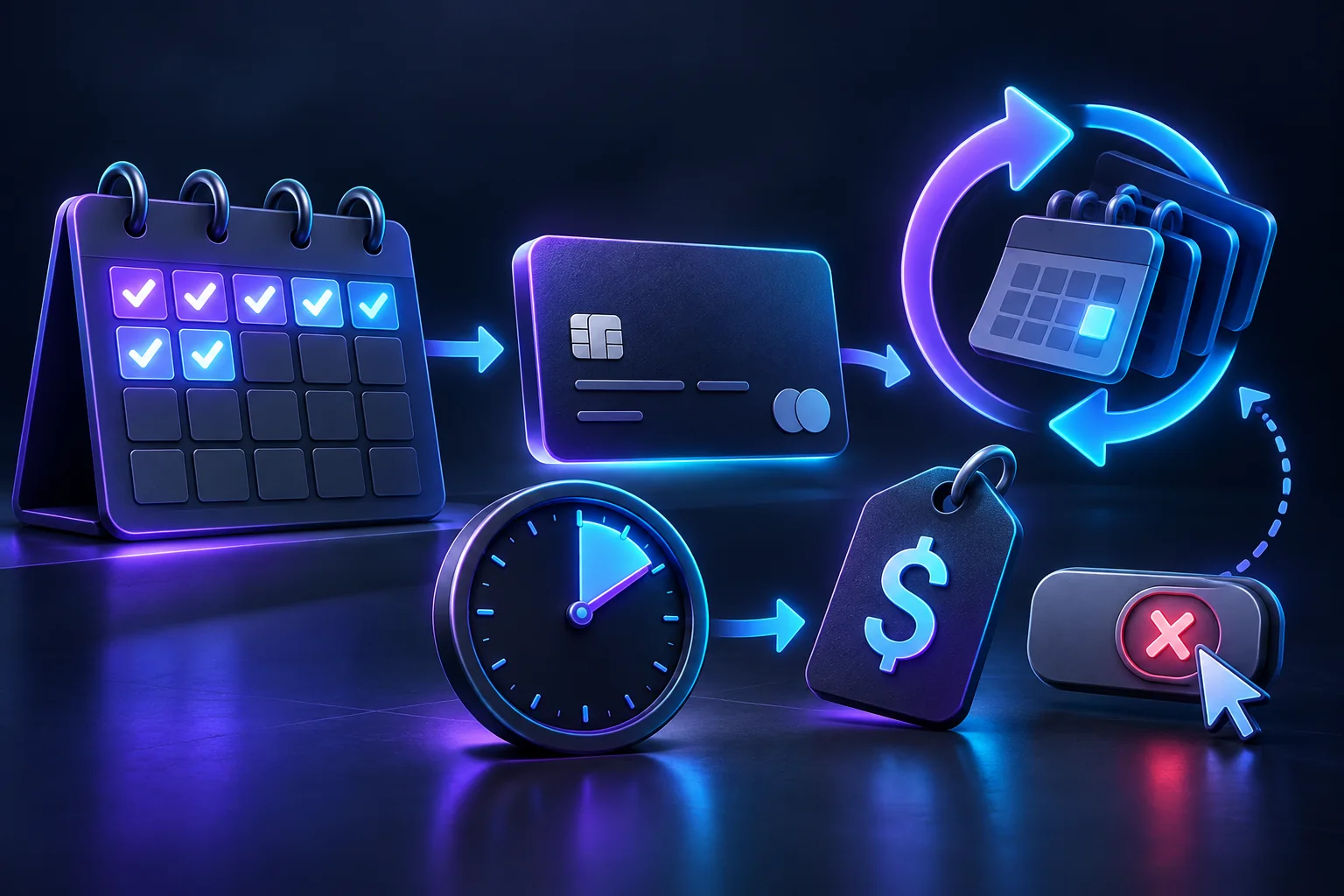
The largest number on an AI pricing page may not tell you what you will pay today or over the full term. Before purchasing, separate the upfront amount, the billing period, the next renewal and any usage-based charges.
This guide provides a way to read an offer. It does not list current prices for a particular service or suggest that a review website sets the prices of external applications.
Calculate the commitment rather than the headline
A price expressed per month can be an equivalent rate for a year paid upfront. In a hypothetical example, an offer of $8 per month billed annually means a $96 annual amount before any applicable taxes or extras. It is different from a plan that charges $8 each month and can be ended before the next monthly renewal.
Write down the amount due at checkout and the period it covers. If an introductory discount applies, identify the later price separately. Do not assume that the discounted amount will continue indefinitely.
Currency can also matter. The merchant's stated amount, any applicable taxes and the card provider's conversion or foreign-transaction treatment are different parts of the final cost. Check the actual payment terms rather than adding an estimated universal fee.
Identify what the payment includes
A subscription may grant access while some actions consume a separate allowance. Look for limits on usage, restrictions on particular features and the conditions attached to extra purchases. Avoid interpreting “premium” as a complete description of what is included.
For a neutral example, a design application could include a monthly allowance of exports but charge separately for another feature. The example does not describe any named provider. The guide to credits, tokens and subscriptions explains why units need to be understood before comparing headline quantities.
Check the renewal and cancellation terms
Find the renewal date, recurring amount and cancellation route. A successful payment confirmation is not necessarily a clear explanation of the next charge, so retain the offer and subscription confirmation together.
The FTC's guidance on trials and automatic renewals encourages consumers to examine the terms before providing payment details. For a closer look at introductory offers, see free trials and automatic renewals.
An offer being available through a familiar payment method does not establish that it suits your needs. Payment security, value and cancellation terms are different questions.
Do not treat unused access as a guaranteed refund
Find the refund policy before purchasing, including any stated conditions and the relevant contact route. Do not assume that unused credits, immediate cancellation or an account you rarely opened automatically entitle you to a refund. Applicable consumer rights can also depend on your jurisdiction and the circumstances.
If the final amount differs from what you expected, pause before confirming the purchase. Resolving uncertainty in advance is easier than reconstructing an offer later from memory.
Keep a short purchase record
Save the plan name, amount, currency, billing period, renewal terms and receipt. Exclude full card numbers and security codes from your notes. A short record is useful if you later need to explain a discrepancy without exposing unnecessary financial information.
If a charge has already appeared that you do not understand, use how to request help with unexpected AI charges rather than buying another plan in an attempt to fix the account.
Related reading
Credits, Tokens and Subscriptions: How Billing Models Differ