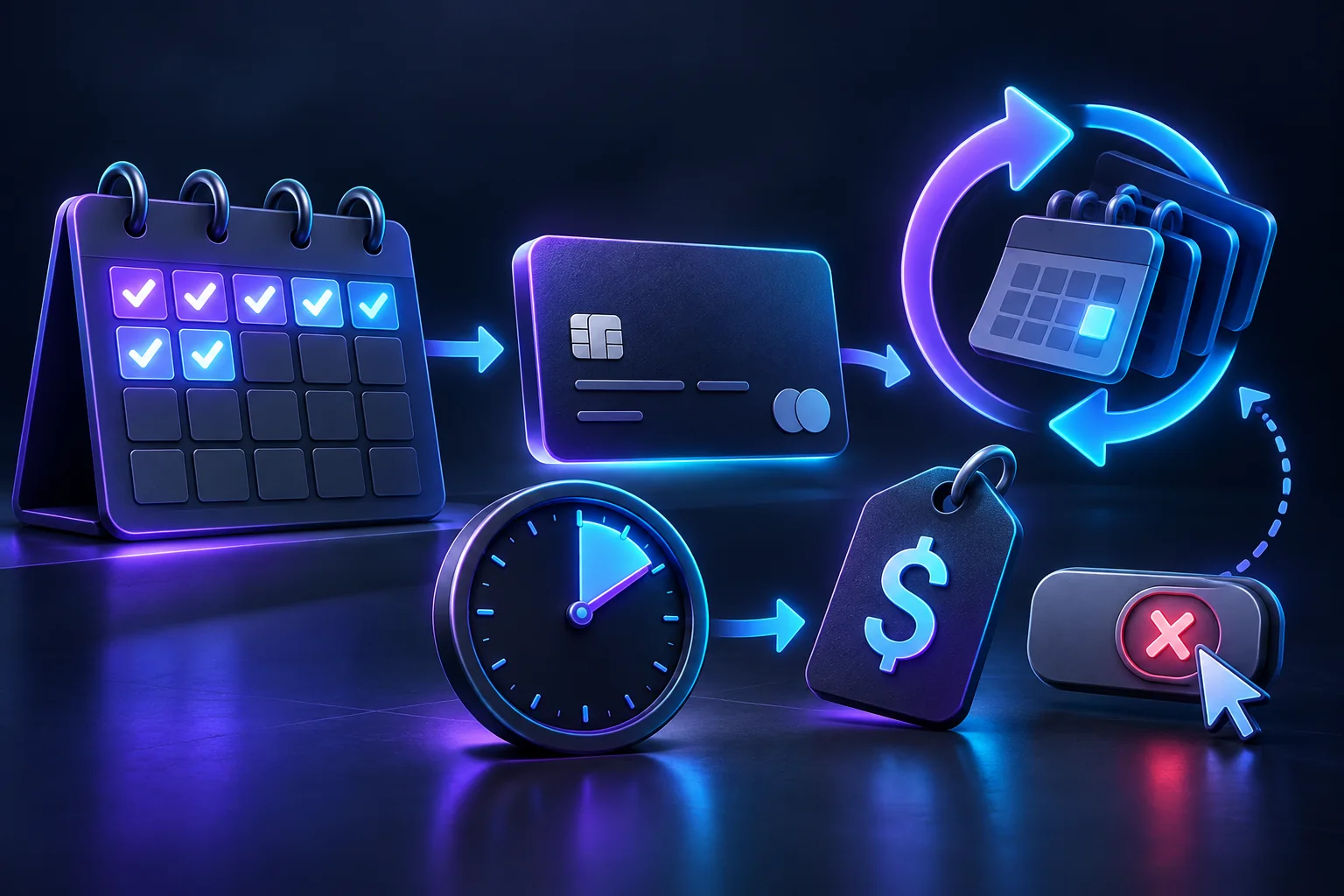
A free trial can become a paid subscription if that is part of the offer you accept. A free account or complimentary credit allowance may work differently. Before registering, identify which arrangement is being offered and whether any future payment is authorised.
The word “free” does not answer how long access lasts, what happens afterwards or how to stop renewal. Read those conditions before supplying payment details.
Identify the event that starts the trial
Look for whether the trial begins when you register, activate an offer or complete checkout. If the start point is unclear, ask before proceeding. Do not assume that the countdown begins with your first substantial use.
Record the displayed end date and any cancellation cutoff, including the relevant time zone if one is stated. A personal reminder set before that cutoff is more useful than relying on memory. It is not a substitute for completing the cancellation process.
For example, an offer could display a specific renewal timestamp rather than ending at midnight in your own location. This is a hypothetical issue to check, not a claim that all services use the same convention.
Write down the amount after the trial
Distinguish the trial period from the paid billing period. A short introductory trial might lead to monthly or annual billing, and the first charge can differ substantially depending on that arrangement.
The FTC's consumer guidance on free trials and renewals warns that introductory offers can lead to charges and advises reviewing the terms. Our guide to AI subscription costs explains how to separate an advertised monthly equivalent from an amount billed upfront.
Keep a copy of the terms presented when you accept the offer. A pricing page viewed weeks later may describe a different promotion.
Separate trial access from free units
An account with a small free balance does not necessarily enrol you in a subscription. Equally, receiving some free credits does not establish that there is no recurring charge attached to another part of the offer.
Check the payment confirmation and account billing information. The distinction between credits, tokens and subscriptions is especially important when a single page displays several kinds of allowances.
Avoid entering payment information merely to investigate an offer you do not understand. A clear explanation should be available before you commit.
Understand what ends the renewal
Stopping use is not the same as cancelling. Uninstalling an application also should not be treated as cancellation: Google Play explicitly explains that uninstalling an app does not cancel its subscription.
Find the relevant billing channel and complete its cancellation process. A retention offer, pause option or discount screen is not necessarily the final confirmation. Check what the resulting status says and retain it.
Use how to document a cancellation if you want a record of the request and effective date. Whether unused access continues depends on the actual terms.
Check afterwards without assuming a refund
Review the next relevant statement or transaction history to see whether the expected outcome occurred. If a charge appears, compare its date and description with the saved terms and confirmation before deciding what question to raise.
Cancelling future renewal does not automatically reverse an earlier charge. Refund rights and dispute options depend on the payment method, applicable rules and circumstances. Contact the responsible provider promptly if the record does not match what you agreed to.
Related reading
AI Subscription Costs: What to Check Before Paying
Credits, Tokens and Subscriptions: How Billing Models Differ